Banks put enormous effort into acquisition. We track application starts, approval rates, funded accounts, and cost per acquisition.
But what happens after the account opens?
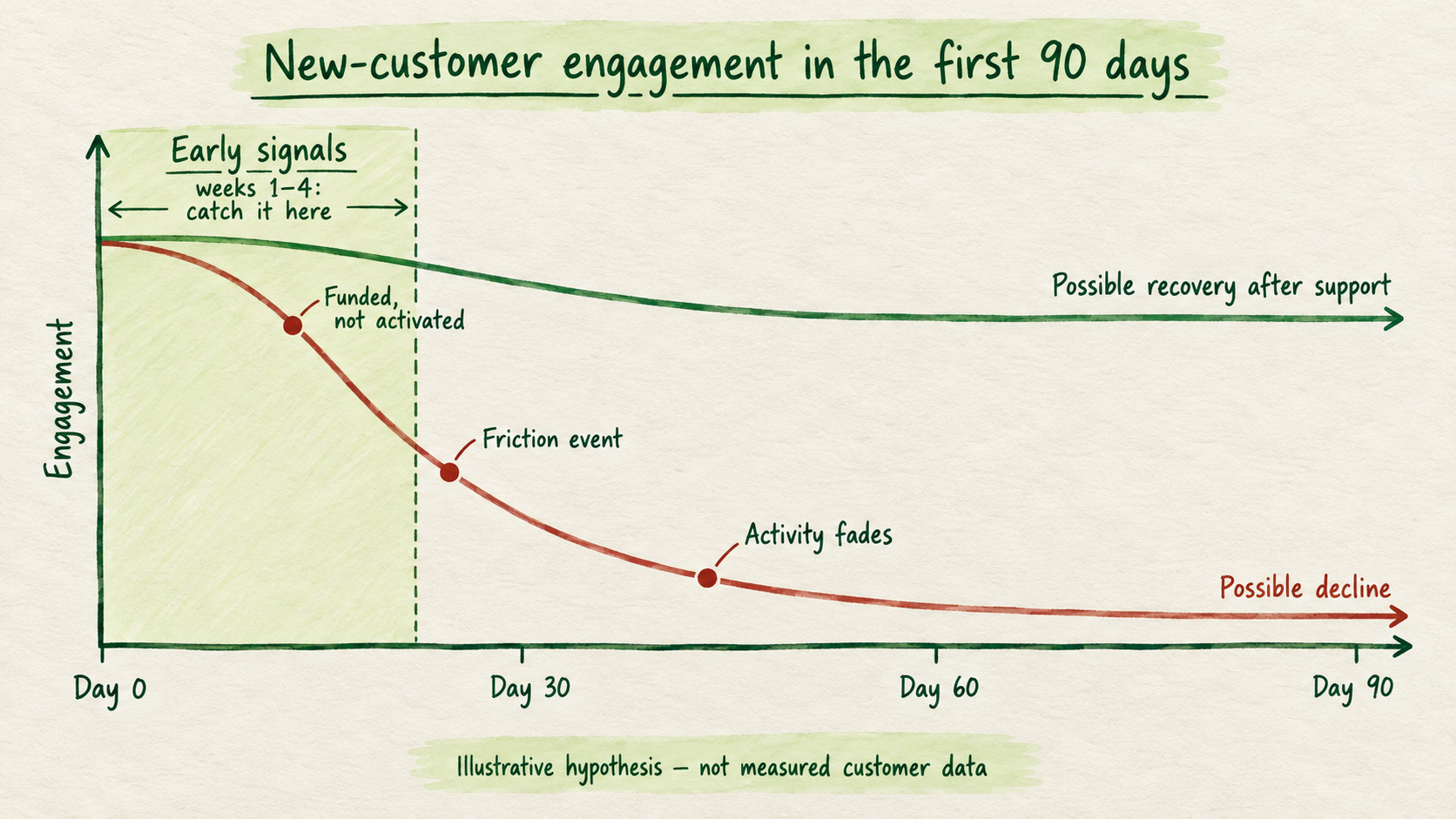
Some customers begin building a routine. Others quietly disengage. I think of this gap between opening an account and forming a relationship as the onboarding cliff.
The first 90 days give us a useful window to investigate it. AEP and CJA can help connect the story—provided we define the milestones, validate the data, and act on what we learn.
1. Recognize the early patterns
A customer may have opened an account for a rate, a promotion, or a life event. That does not mean the bank has become part of their routine.
Three patterns are worth investigating:
- The account that never activates. A checking account is funded, but the customer has not set up direct deposit, moved a recurring payment, or used the card.
- The early friction event. A failed transfer, an unexpected fee, or an unsuccessful login is followed by reduced activity.
- The comparison shopper. The customer may be trying several banks before choosing a primary relationship. Your activity data alone cannot establish whether this is happening.
Low activity is a signal to investigate, not proof of churn. Interpret it against the product, account age, and data completeness. A savings customer may rarely need to log in; a delayed transaction feed can resemble disengagement.
2. Connect the fragments of the journey
The onboarding story often lives across separate systems:
- Acquisition: Application, approval, account opening, and funding.
- Digital behavior: Web visits, app activity, enrollment, and failed actions.
- Service: Contact-center interactions, repeat contacts, and resolution status.
- Core banking: Transactions and account activity.
Each system provides part of the answer. The useful question spans all of them:
The questionWhich newly onboarded customers are showing patterns associated with later inactivity—and where could we help?
In AEP and CJA, the foundation is to:
- Model relevant activities as events, with product and customer attributes in appropriate supporting datasets.
- Configure the CJA connection around compatible Person IDs, using identifier mapping or supported stitching where needed.
- Preserve account and application identifiers: one person may hold several accounts, and a joint account may involve several people.
- Validate identity coverage, timestamps, and source completeness before interpreting the journey.
That makes it possible to examine funding, first login, a failed transfer, a service call, and subsequent activity as one connected sequence.
3. Define what activation means
Choose two or three milestones appropriate to the product. For a checking-account use case, candidates include:
- Digital banking enrollment.
- First card transaction.
- First qualifying direct deposit.
- First recurring payment.
Be precise about the definitions. Starting direct deposit setup and receiving a deposit are different events.
In CJA:
- Use fallout analysis when a particular sequence matters.
- Measure milestone completion separately when customers can take different paths.
- Compare customers at the same account age.
- Test whether the early milestones are associated with a defined later retention outcome.
A customer at day seven should not be evaluated as though they have already had 90 days to establish a routine.
4. Investigate the warning signs
Start with candidate patterns rather than assuming every quiet account is at risk:
- Stalled activation: Funding occurred, but the next relevant milestone is missing.
- Unresolved friction: A failed action or repeated service contact has no recorded resolution.
- Declining activity: Engagement drops relative to the customer's earlier behavior and expected product use.
Before acting, check:
- Have the relevant source feeds arrived?
- Is identity coverage complete enough to connect the activity?
- Could the customer have completed the action through another channel?
- Has the cohort had enough time to reach the outcome being measured?
The goal is to find reliable early indicators, then test their relationship with later inactivity or account closure.
5. Build the audience and match the intervention
A CJA filter can identify a candidate group for analysis. The filter alone does not trigger outreach.
Configure the audience publication or operational activation workflow, including identity mapping, refresh timing, and downstream processing.
Match the response to the observed issue:
- Incomplete setup → Guidance on the unfinished step.
- Unresolved transfer or login problem → Relevant service assistance.
- Missing expected milestone → A helpful reminder after checking eligibility and context.
- Completed milestone → Suppression from further reminders for that action.
A generic “we miss you” message does little to resolve a specific problem.
6. Apply contact rules and recheck the latest state
Before any intervention:
- Apply the bank's consent, channel-permission, and eligibility rules.
- Cap contact frequency across relevant communications.
- Recheck whether the customer has already completed the milestone.
- Review current service status so outreach fits the situation.
- Assign ownership for completion feedback and suppression.
Yesterday's risk signal should not create an unnecessary message today.
7. Close the loop and measure the effect
The program only becomes useful when we learn whether the intervention helped.
- Capture assignment and outcomes. Record who was assigned to each treatment and what happened afterward.
- Use a comparable holdout where appropriate. Randomize eligible customers without withholding necessary service.
- Define success in advance. Measure the relevant milestone, issue resolution, sustained activity, or account retention.
- Use consistent follow-up windows. Give treatment and holdout groups the same opportunity to reach the outcome.
- Watch unintended effects. Review complaints, opt-outs, and additional service contacts.
- Refine the program. Keep effective interventions and revisit weak signals.
More activity after a message does not, by itself, prove the message caused it.
A practical starting checklist
Where to start.
- Choose one product and define the onboarding start event.
- Agree on two or three activation milestones.
- Connect the required datasets and validate identity coverage.
- Check data completeness before interpreting missing activity.
- Test one candidate risk pattern in CJA.
- Configure the audience and intervention workflow.
- Apply contact rules and completion suppression.
- Measure outcomes against an appropriate comparison group.
The acquisition dashboard tells us that a customer arrived. The next step is to understand whether the relationship is taking shape—and where the bank can help it move forward.