A shared audience does not automatically create a shared journey.
A customer may receive an email, visit the website, complete a service interaction, and continue appearing in an advertising audience. Each application may operate correctly within its own configuration while the overall experience remains disconnected.
AJO addresses the sequencing problem. It can coordinate when to request a decision, send a message, wait, check an outcome, or end further treatment.
The external audience still supplies the original selection. AEP and RTCDP still provide the customer foundation and final audience conditions. Pega contributes decisioning or an external action. Adobe Target controls configured website experiences. Meta and Google deliver advertising.
AJO owns the progression through the experience. It does not replace every execution system.
This architecture follows the requested stack: Pega, native AJO email, Target, Meta, and Google. Zeta remains the campaign destination in the companion architecture without AJO.
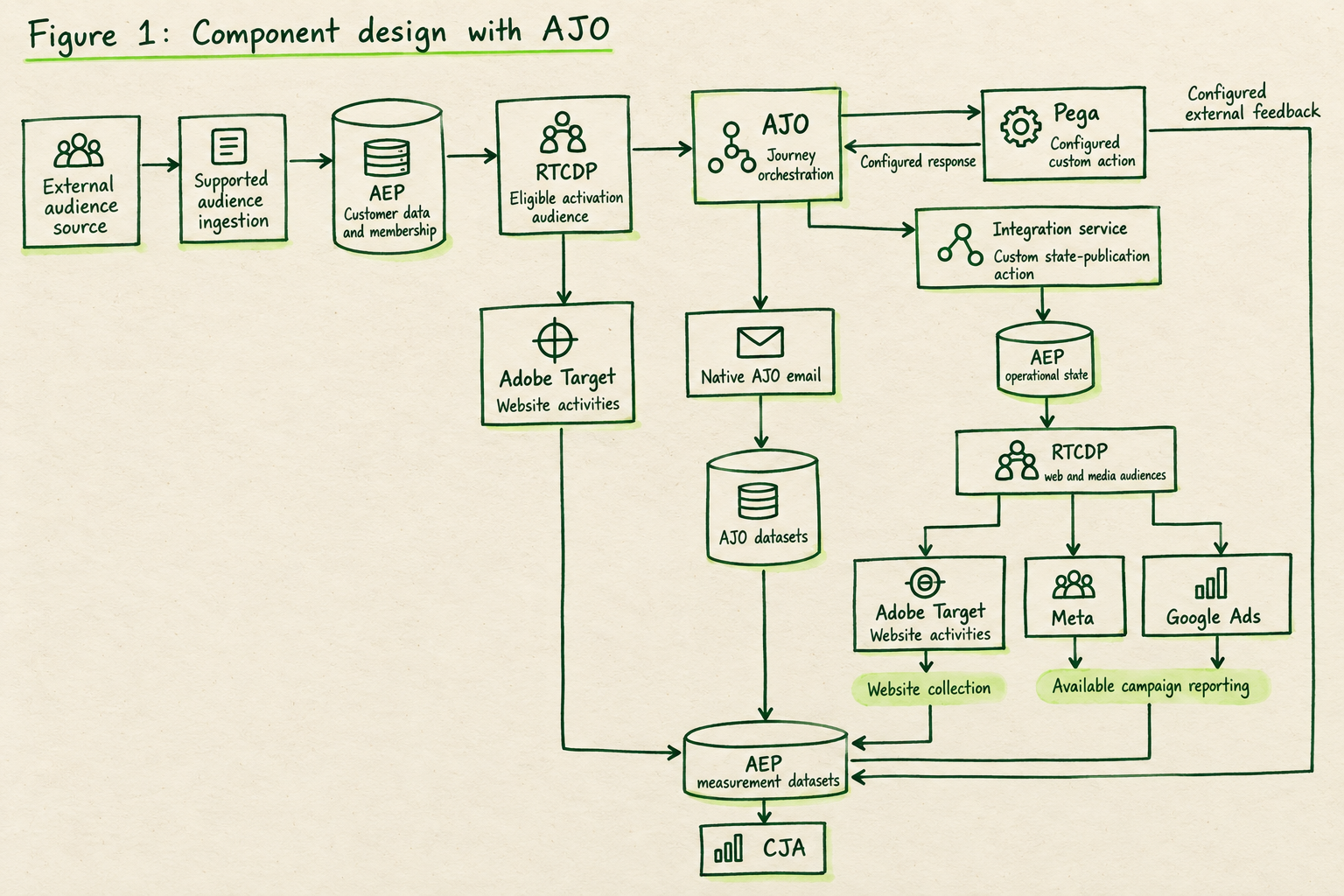
The direct RTCDP-to-Target path allows website personalization based on the existing audience. The journey-state path is needed only when website or media eligibility must change according to journey progression.
Both paths to Target represent audience conditions delivered through the configured platform connection, not two mandatory destination configurations.
The swimlane places AJO between qualification and action
The external source calculates membership. RTCDP prepares an eligible population. AJO accepts that population through a supported entry mechanism and coordinates subsequent steps.
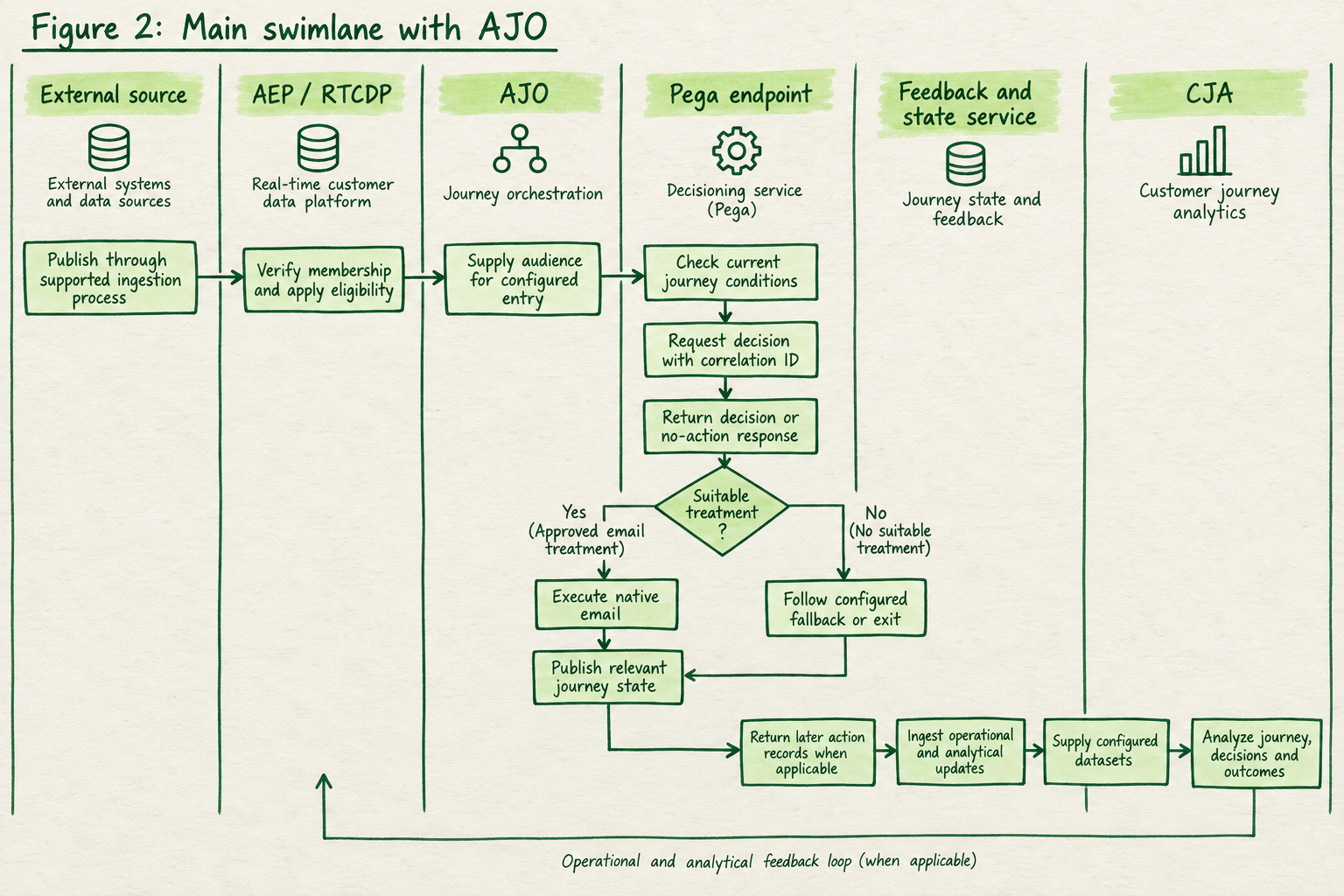
The Pega endpoint in this swimlane is an AJO custom integration. It is not the same connection as the RTCDP Pega destination in the architecture without AJO.
Adobe documents custom actions and configurable responses ↗ for external services. The Pega integration still requires its own authentication, request mapping, response contract, and failure behavior.
The ingestion foundation remains the same
The external source publishes membership, identity information, and provenance. Adobe receives the selection without acquiring the model's executable logic.
The publication must retain source ownership and freshness. An API-managed ingestion process should track creation, ingestion runs, and their status before releasing downstream use. External Audiences API ↗
Additional audience context must be distinguished from durable customer state. A treatment code associated with one selection is different from a current customer eligibility attribute.
Consent information should use the appropriate profile-ingestion path rather than being treated as external-audience payload. Adobe external-audience FAQ ↗
The AJO entry mechanism must match the audience type. Read Audience ↗ supports scheduled population processing. Adobe documents restrictions on using custom-upload and composition audiences in Audience Qualification activities ↗.
Creating a derived audience does not justify assuming instant evaluation or automatic payload propagation. Test the final audience and the fields available to the consuming journey.
Decision ownership prevents duplicate action
| Decision | Owner in this design |
|---|---|
| Original model qualification | External source |
| Final audience eligibility | RTCDP |
| Journey sequence and waits | AJO |
| Specialist treatment recommendation | Pega |
| Email execution | AJO |
| Website activity execution | Adobe Target |
| Advertising delivery | Meta and Google |
| Cross-channel analysis | CJA |
Pega might return a recommendation for AJO to execute. Alternatively, an AJO request might ask Pega to initiate an external action. Those are different contracts.
If Pega only recommends an email treatment, AJO sends it. If Pega initiates the action, AJO should not duplicate the same action unless that is intentional. A response acknowledging a request is also different from a completed customer interaction. Later feedback remains necessary.
The request should carry a stable correlation identifier. For endpoints that create side effects, retry handling should prevent duplicate execution. Timeouts need a defined outcome: defer, use an approved fallback, or exit.
AJO's external-call throughput must respect receiving-system capacity. Adobe provides throughput controls ↗ for these integrations.
The journey should respond to current facts
A hypothetical service-retention journey begins with an eligible customer. It asks Pega for a treatment, sends an approved email, and waits for a defined response window.
If the customer completes the desired interaction, further treatment stops. Otherwise, the journey checks whether website or paid-media support remains appropriate.
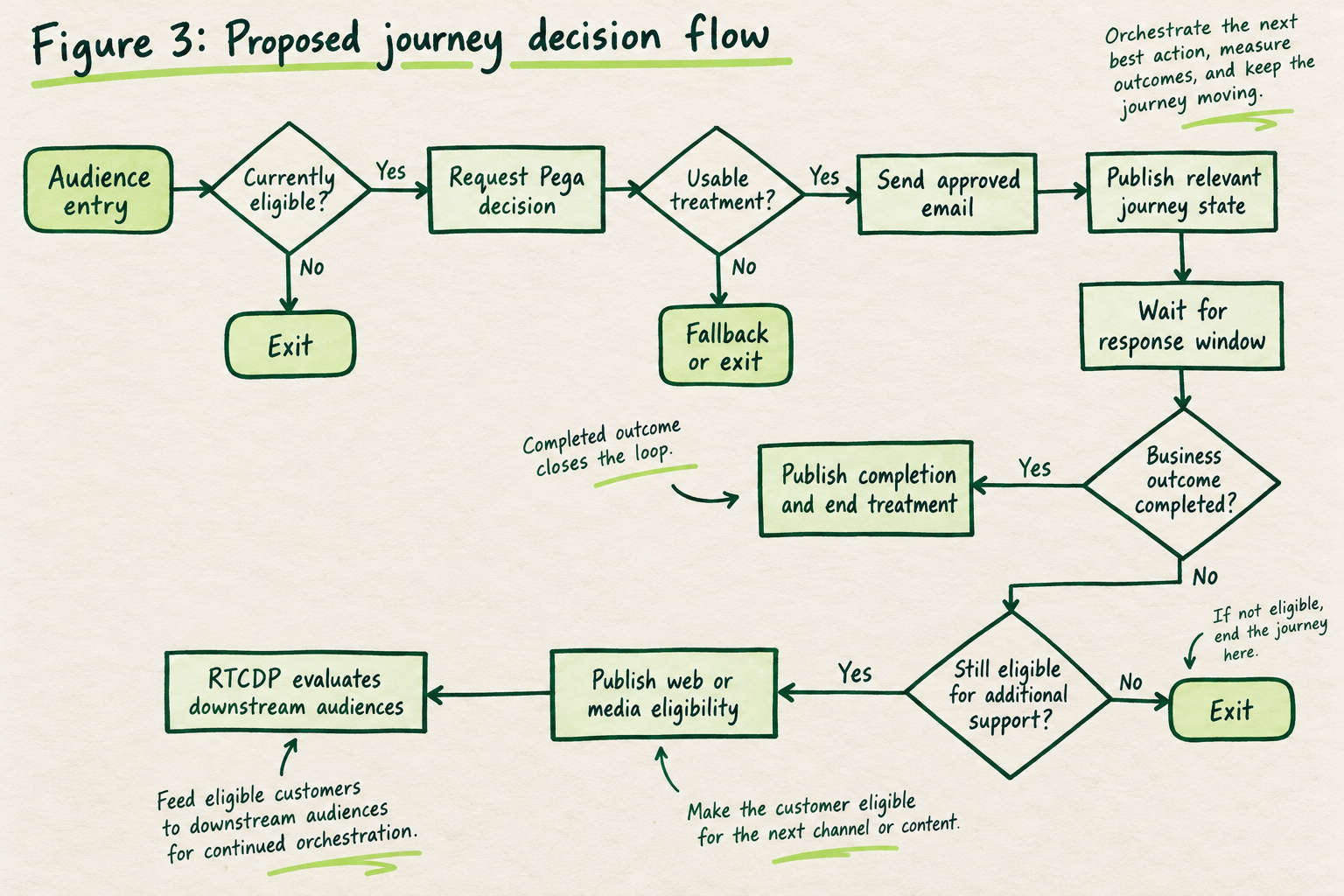
These conditions and publication steps are proposed implementation logic. Journey entry does not permanently establish eligibility. A customer's situation may change while waiting.
Adobe states that audience enrichment values retain their entry-time values during the journey. When later actions depend on current information, the design needs an appropriate current-data check. AJO enrichment attributes ↗
Target brings journey context onto the website
Website personalization can use the initial RTCDP audience. It can also use implemented state changes when the intended experience depends on journey progress.
For example, a customer who has received a service-review email might encounter a consistent invitation on the website. A customer who has completed the review might receive a confirmation or a different service experience.
The integration must define how that state becomes available to Target's configured activity. AJO does not need to call Target for every page view. The website requests an experience through its Target implementation, while the relevant audience and customer context inform activity eligibility.
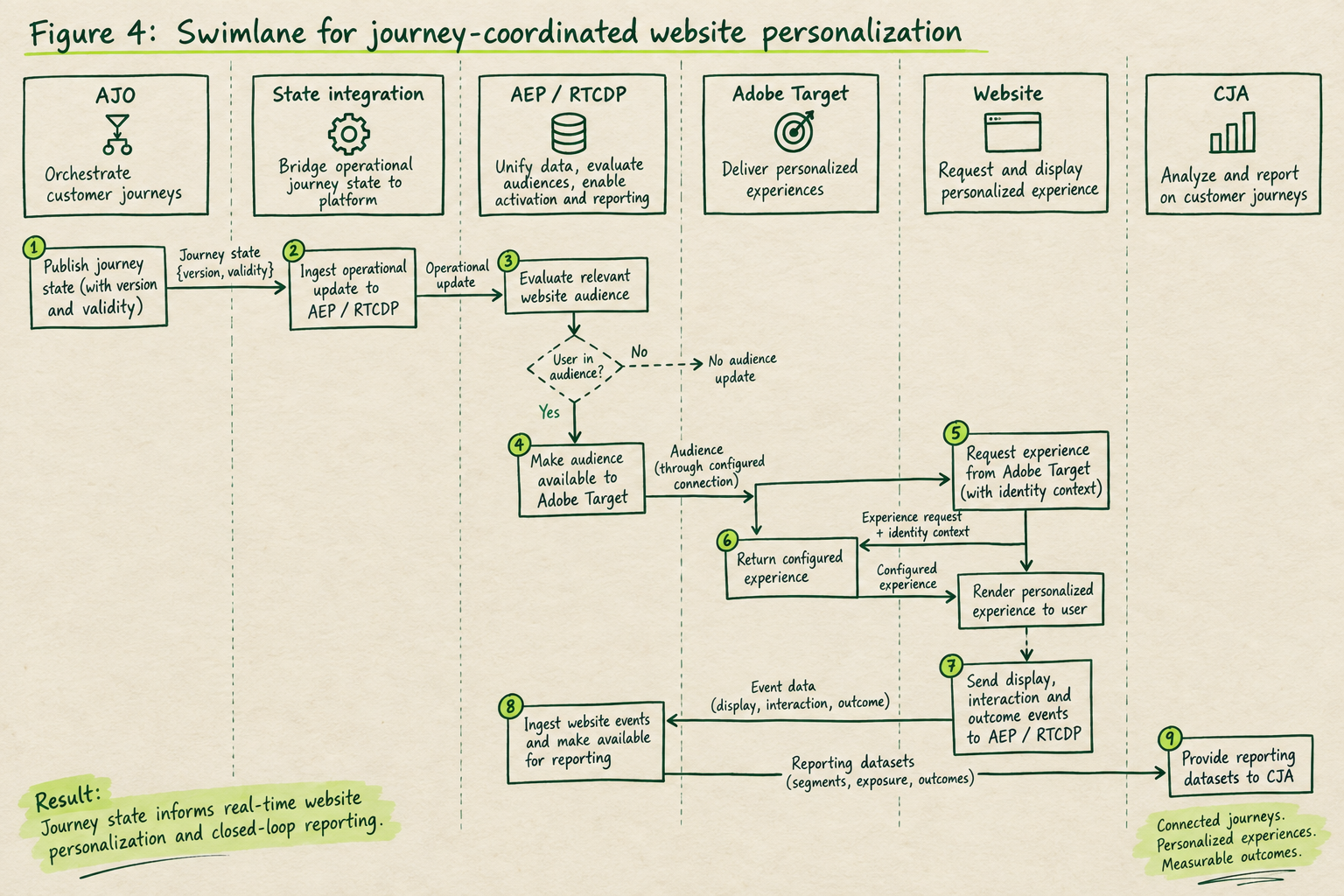
This is an implemented coordination process, not an automatic journey action. The website also needs a fallback when identity is unavailable or updated membership has not reached the personalization path.
Target supports different personalization timings depending on its implementation and audience configuration. Same-page behavior should not be promised merely because the source audience exists in Adobe. Target connection and timing ↗
Paid media follows a similar state-publication pattern
AJO determines that the customer is eligible for advertising support. An integration service records the relevant state in AEP. RTCDP evaluates an audience and activates it through Meta or Google destinations.
The journey does not assume that publishing eligibility produces an immediate impression. The state model should include a validity boundary and ownership. If multiple journeys contribute to the same advertising program, one journey's exit should not inadvertently remove eligibility still required by another.
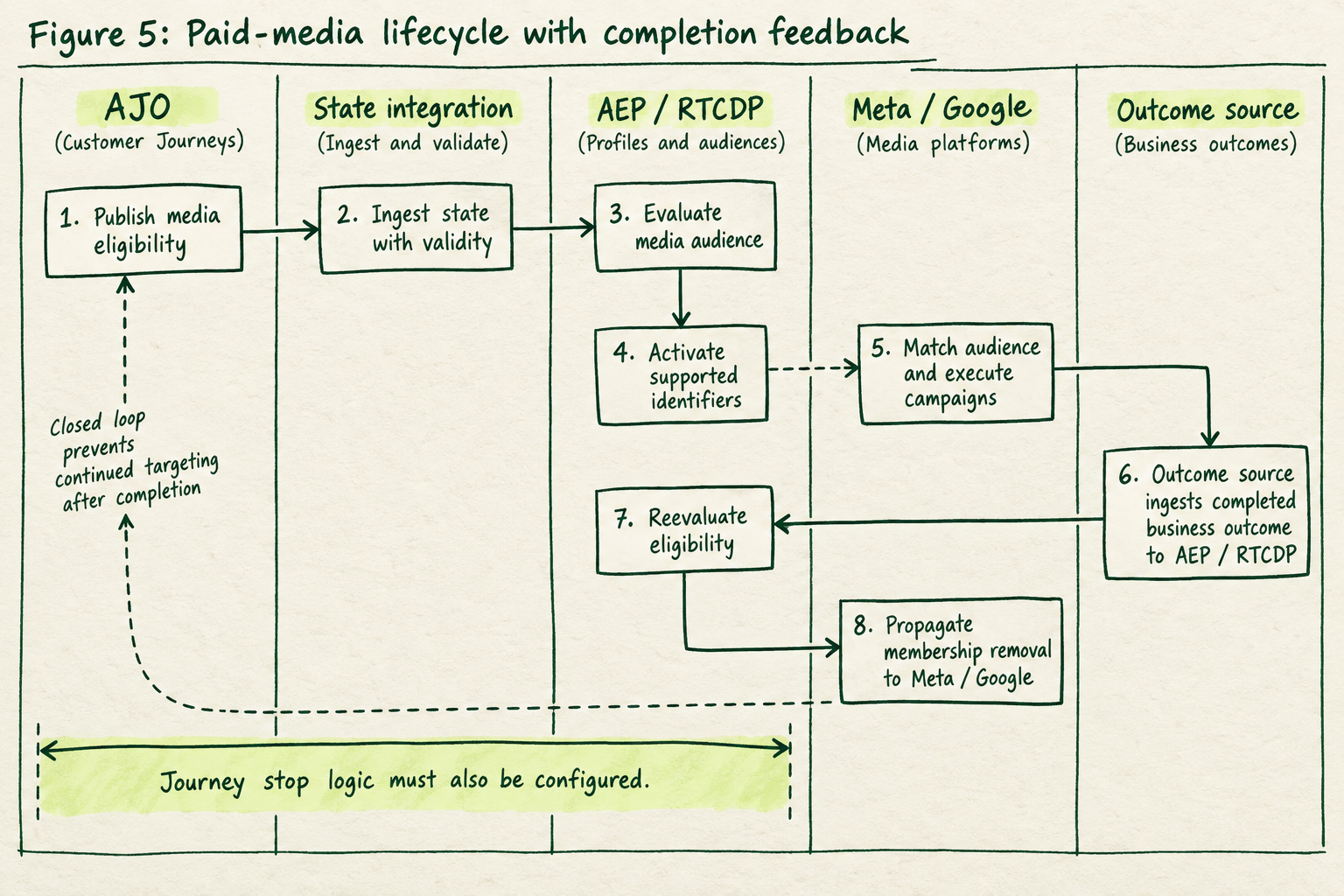
Outcome ingestion does not automatically terminate every active journey. AJO must have the relevant event handling, conditions, or exit behavior configured for that purpose.
The state model is central to operating this architecture
A proposed state record can distinguish a journey instance from the customer's overall profile.
| State concept | Why it is needed |
|---|---|
| Customer identifier | Associate the update with the intended person. |
| Journey instance and version | Identify the specific execution context. |
| State version | Reject or resolve out-of-order updates. |
| Treatment or decision reference | Connect orchestration to Pega's response. |
| Website or media eligibility | Express the downstream condition. |
| Validity time | Avoid indefinite eligibility. |
| Completion reason | Explain why treatment ended. |
| Correlation ID | Connect requests, actions, and feedback. |
These are design concepts, not a required Adobe schema. The implementation should define how concurrent journeys are reconciled and whether late state updates are ignored, superseded, or corrected.
A completed journey should not be reopened operationally by a delayed earlier “eligible” update.
CJA measures the sequence, not just the individual channels
Adobe documents AEP as the foundation connecting AJO data to CJA. The relevant datasets and analysis components still need to be configured. AJO and CJA integration ↗
The analytical design should connect source audience history, RTCDP activation, AJO journey entry, Pega decisions, email events, Target exposures, available media reporting, and business outcomes.
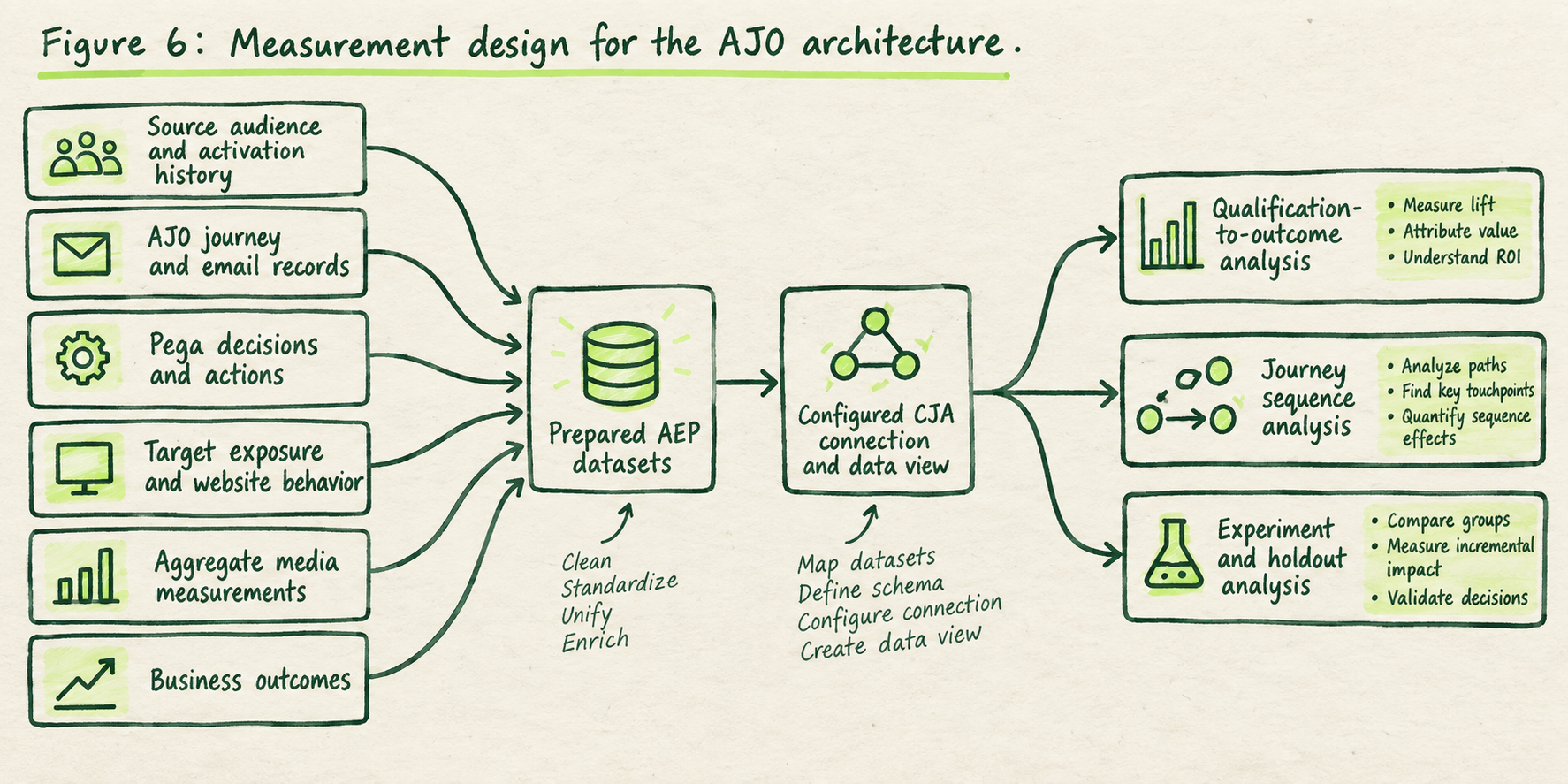
Analysts can investigate where customers exit, which treatments are selected, whether website experiences reinforce email, and how long the full process takes.
Branch comparisons require care. Customers reaching a later advertising step may be less responsive because they did not complete the earlier step. Their outcomes cannot be interpreted as a clean comparison with customers who completed after email. Randomization at the relevant decision point provides stronger evidence.
The measurement design should distinguish assignment from exposure. A customer may be eligible for a Target activity without visiting the website, or belong to an advertising audience without receiving an impression. The architecture becomes trustworthy when those distinctions survive the data pipeline.
Choosing the model
AJO coordinates progression without replacing specialist execution.
This model suits organizations that want explicit control over journey timing and sequence, while Pega, Target, and advertising platforms retain their execution roles.
The external audience remains the starting intelligence. The journey determines how that intelligence becomes action, and CJA evaluates the resulting customer experience.
Both architectures preserve externally created intelligence. The choice is whether execution remains distributed among destination systems or follows a journey coordinated by AJO.
Choosing between the two swimlanes
| Design decision | Without AJO | With AJO |
|---|---|---|
| Original audience logic | External source | External source |
| Activation audience | RTCDP | RTCDP |
| Journey progression | Distributed across destination processes | Coordinated in AJO |
| Pega interface | RTCDP destination | Configured custom action |
| Email execution | Zeta or selected destination | Native AJO |
| Website execution | Adobe Target | Adobe Target |
| Advertising activation | RTCDP | RTCDP with implemented journey eligibility |
| Main integration challenge | Cross-system coordination and feedback | State consistency, correlation, and external-action handling |
| Measurement | AEP datasets and CJA | AEP datasets and CJA |
Before scaling either design, test the full lifecycle with known customers: entry, identity association, action, suppression, outcome, feedback, and removal.
Also test stale audiences, failed publications, retries, duplicate events, unavailable website identities, and delayed completion signals. Define the expected behavior before those conditions occur in production.