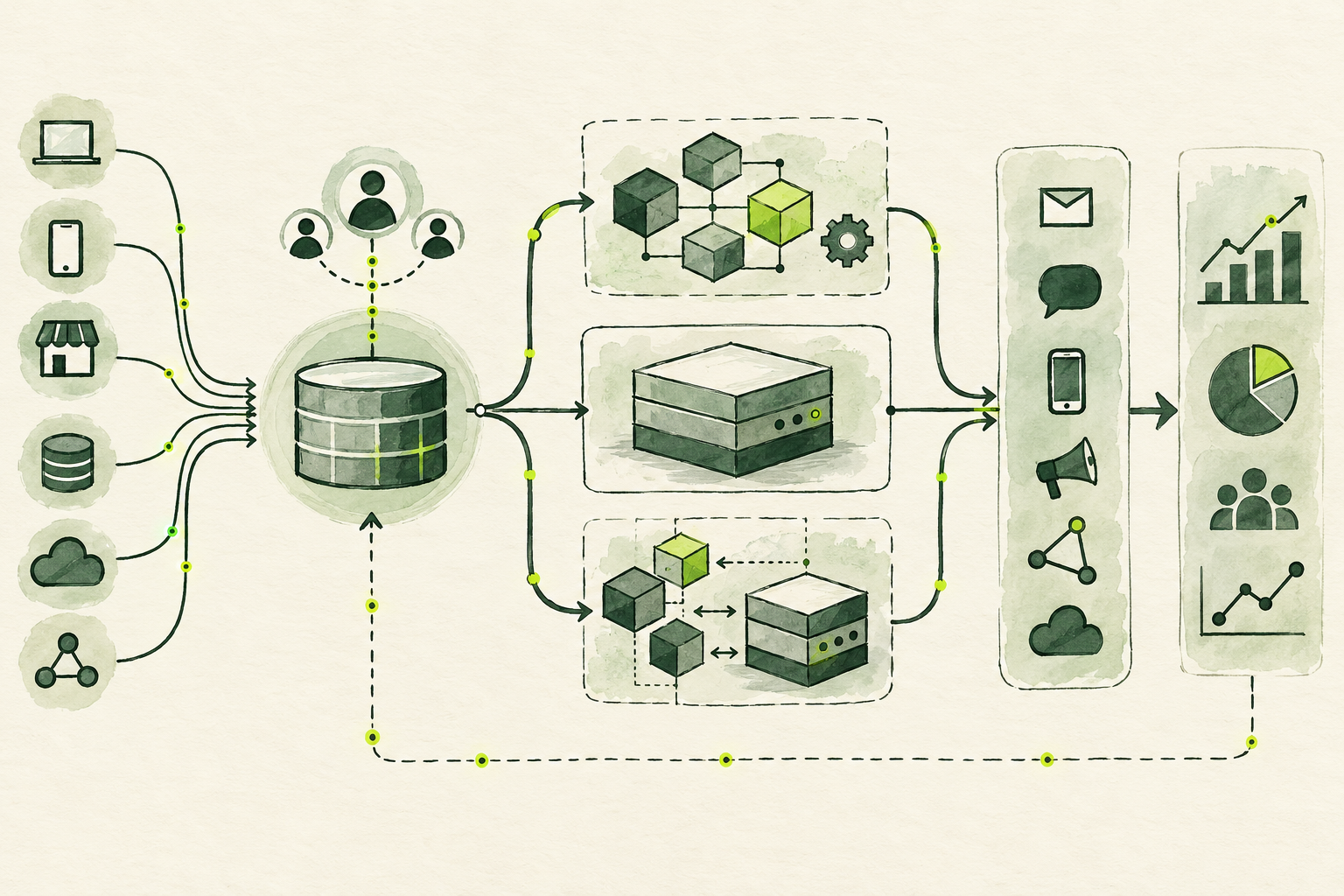
A visitor browses a company’s website, expresses interest in a product, returns through another channel, and eventually becomes a customer.
Meanwhile, the business may have partner audience data, licensed prospect attributes, purchase history, and service interactions spread across several systems.
Which customer data platform is right for that environment?
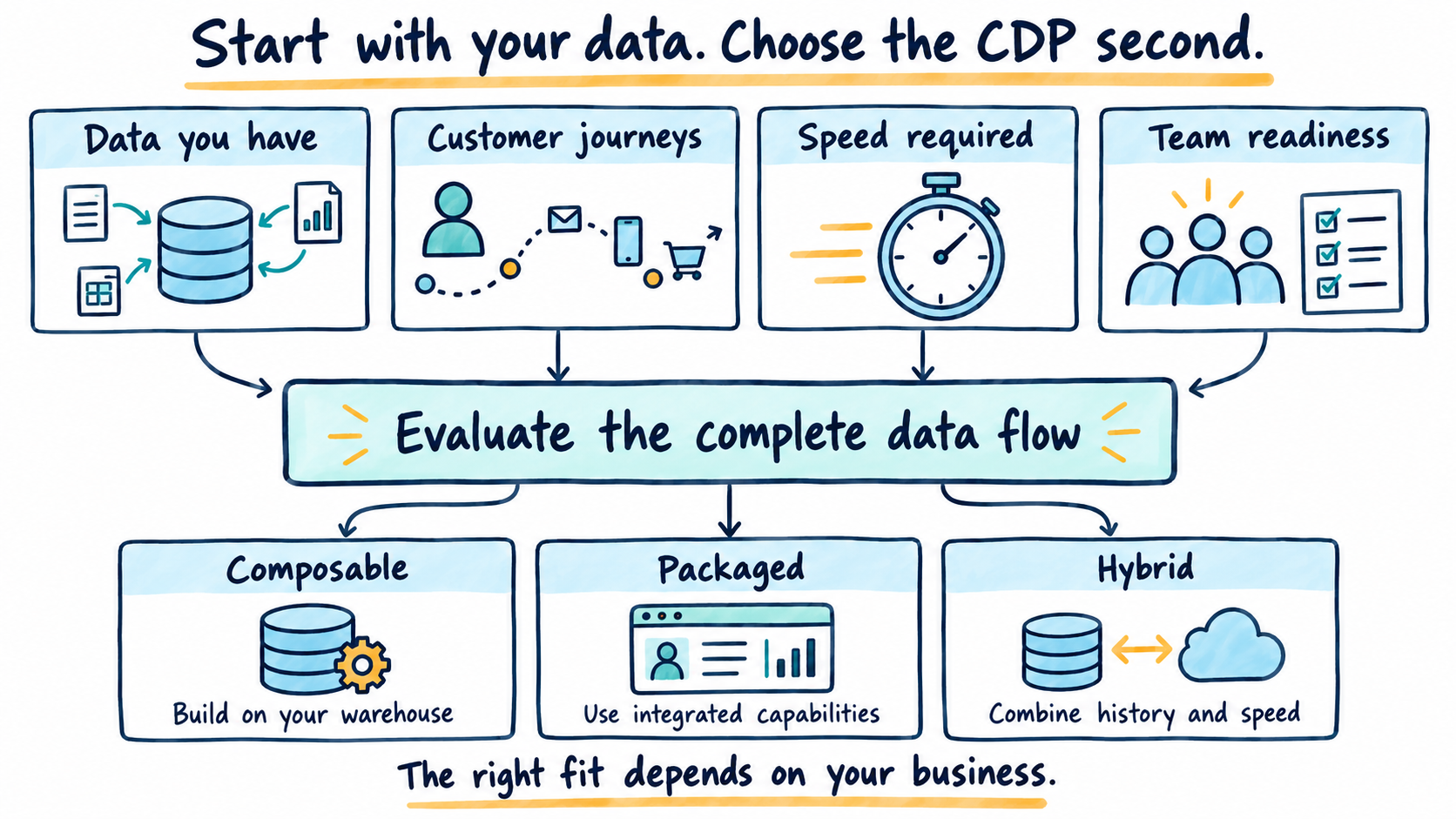
When I think about CDP selection, I start with the customer journey and work backward. What data do we have? Which signals come from our own platforms, and which come from partners? How quickly must those signals change the experience? How well can our existing systems support that flow?
Those questions shape how I evaluate composable, packaged, and hybrid approaches. A strong warehouse foundation may make composable activation a natural fit. Prospect acquisition, complex identity relationships, or immediate personalization may require additional capabilities and a different integration design. The right balance depends on the business and its data.
My view is straightforward: choose a CDP around the data you have, the experiences you need to deliver, and the operating model you can support. Then design the surrounding architecture so that changing the CDP does not mean rebuilding your entire data foundation.
The categories are becoming less distinct
Composable describes how capabilities can be assembled. Warehouse-native describes where particular processing and data-management activities happen. These concepts overlap, but they are not interchangeable.
A warehouse-centered implementation might combine collection, identity resolution, audience creation, and activation from several providers. A packaged CDP bundles more of those capabilities. A hybrid architecture combines a durable warehouse foundation with specialized services for immediate interactions.
These architectural boundaries increasingly overlap. Salesforce now calls Data Cloud Data 360 and supports zero-copy connections to external data platforms. GrowthLoop and Hightouch emphasize warehouse-centered activation, while Adobe combines unified profiles, audiences, and experience activation within AEP. These are reasons to evaluate actual data flows rather than assign permanent labels. Salesforce Data 360 ↗, GrowthLoop ↗, Hightouch ↗, Adobe Real-Time CDP ↗
Nor should “warehouse-native” be read as a promise that data never moves. Activation sends selected data to destinations; particular services may also use caches, external processing, or supporting storage. Ask for the deployed architecture, including those components.
Start with the data you actually have
Before comparing vendors, establish what the business needs to connect.
| Data situation | What the architecture needs to handle |
|---|---|
| First-party behavior and transactions | Consistent events, customer identifiers, authoritative outcomes, and reliable refreshes |
| Second-party data shared directly by a partner | Agreed identifiers, permitted uses, provenance, refresh schedules, and partner-specific restrictions |
| Third-party data licensed from a provider | Provider coverage, match quality, usage rights, expiration, and destination compatibility |
| Anonymous visitors | Session and device context without assuming that every visitor can be identified |
| Known prospects | Lead or prospect identifiers and a controlled transition into the customer lifecycle |
| Partner-sourced prospects | A separate understanding of provider identity, confidence, permitted activation, and customer overlap |
| Existing customers with multiple accounts | Explicit person, household, organization, and account relationships |
A large warehouse is not automatically a usable customer foundation. It may contain duplicate records, inconsistent identifiers, stale attributes, and business rules that different teams interpret differently.
Moving those problems into a packaged CDP does not resolve them automatically either.
Prospecting changes the evaluation
My concern with a warehouse-first recommendation is strongest when the conversation skips acquisition. Activating known customers from well-modeled warehouse tables is a different problem from reaching prospects whose identities and permissions originate outside your own systems.
However, it would be inaccurate to say that composable CDPs cannot work well with second- or third-party data. Hightouch documents third-party identity integrations. GrowthLoop documents an optional Audience Acuity identity graph integration. Those capabilities make a blanket limitation difficult to defend. Hightouch identity resolution ↗, GrowthLoop identity setup ↗
The practical distinction is how much comes ready for the intended workflow and how much your team must assemble, govern, and operate.
Adobe, for example, documents a prospecting workflow using partner-provided profiles, a prospect schema, Partner ID namespaces, audience creation, and activation. That is a concrete capability to evaluate for acquisition—not proof that every Adobe implementation will outperform every composable alternative. Adobe prospecting documentation ↗
For any shortlisted platform, I would ask it to demonstrate a complete scenario: receive a permitted partner audience, identify existing-customer overlap where supported, suppress ineligible records, activate to the intended destination, and retire the data when its allowed use ends.
Data that cannot be exported into your warehouse may require collaboration or activation within a partner-controlled environment. A warehouse strategy needs to accommodate those boundaries.
Real-time performance is a property of the whole journey
A tightly integrated stack can have an advantage when collection, profile updates, decisioning, and experience delivery work together with fewer integration boundaries. Shared semantics and supported connections can also reduce implementation effort.
But “tightly integrated always delivers the best real-time experience” is too strong. An integrated product may still have scheduled processing, segment restrictions, or downstream delivery delays. A composable design can include streaming services and fast profile access.
The implementation matters regardless of the platform. GrowthLoop and Hightouch can activate warehouse-modeled audiences, while Adobe and Salesforce provide broader packaged profile and activation capabilities. In every case, fast retrieval and freshly computed attributes are separate measurements.
Measure the complete pathCustomer action → collection → identity/profile update → eligibility decision → destination delivery → visible experience.
An API response in milliseconds is not enough if the underlying profile is hours old. Similarly, rapid audience qualification cannot make an advertising destination process a membership change faster than that destination supports.
Set different requirements for different experiences. A same-session message, a sign-up follow-up, and a monthly retention audience do not need the same latency. Evaluate end-to-end freshness, reliability under peak load, and fallback behavior against those requirements.
Comparing GrowthLoop, Hightouch, Adobe, and Salesforce
The following is a fit assessment based on documented capabilities, not a benchmark or universal ranking. The suggested fits and evaluation questions are architectural judgments. Product editions, supported destinations, and implementation choices can change the result.
| Platform | Documented architectural emphasis | Where I would consider it | What I would validate |
|---|---|---|---|
| GrowthLoop | Warehouse-centered audiences and journeys, with identity outputs written to the warehouse and optional third-party graph matching. | Marketing teams working from an established warehouse customer model. | Warehouse readiness, identity refreshes, partner coverage, timing, and operational ownership. |
| Hightouch | Warehouse-based identity resolution and activation. | Organizations seeking to reuse warehouse models and retain visibility into identity outputs. | Identity tier, processing locations, partner integration, and full-path freshness. |
| Adobe Real-Time CDP | AEP-based profiles and audiences, with documented partner-prospect acquisition workflows. | Enterprises evaluating customer and prospect activation alongside an Adobe experience stack. | Identity design, prospect lifecycle, destinations, latency, and additional product requirements. |
| Salesforce Data 360 | Customer unification within Salesforce, with external zero-copy integrations. | Organizations connecting data with Salesforce sales, service, and marketing operations. | Federation versus ingestion, freshness, consumption costs, and dependent products. |
An audience builder does not, by itself, provide a complete experimentation program. A destination connector does not guarantee message delivery. A CDP license does not necessarily include the journey, content, or decisioning products shown beside it in a demonstration.
Evaluate the complete bill of materials and the people required to operate it.
Give tagging and data collection the attention they deserve
If I were starting a CDP project, this is where I would spend time first: how are our websites and apps tagged, what are we collecting, and can we trust what arrives downstream?
It is easy to spend weeks comparing audience builders and personalization features while treating tagging as a setup task. Yet every audience, profile, and decision depends on the signals we collect. If a sign-up event fires twice, an identifier disappears between domains, or a successful submission is never recorded, the CDP starts with an incomplete picture.
Consider a sign-up form. Someone clicks “Submit,” but a validation error prevents the registration from being completed. If our tag records that click as a successful sign-up, we may send a welcome message to someone who is still trying to register and overstate conversion. The collection design needs to distinguish the click, the error, and the confirmed registration. The confirmed outcome should come from the system that actually created the account.
That is why I would agree on a tracking plan before building audiences. For each important event, define what it means, exactly when it should fire, which fields it needs, which system supplies it, and who owns its quality.
- Collect the context that makes the event useful. Include the relevant product, journey step, timestamp, source, and permitted identifiers.
- Keep identity relationships clear. A visitor ID, lead ID, customer ID, and account ID represent different things.
- Build consent into collection and use. Make sure applicable choices travel with the data and affect downstream activation.
- Check the data after it leaves the tag. Look for duplicates, missing fields, timing problems, and differences from operational records.
- Treat tracking as part of every release. Give someone ownership of monitoring and fixing collection changes.
I would also keep the business data layer under our control. “Registration completed” should have an agreed meaning that survives a change of analytics or CDP vendor. Adapters can translate that definition into each platform’s format.
The warehouse needs the same care. It should preserve useful history, make duplicates and late arrivals manageable, and give teams clear, dependable customer and account models.
Reliable tagging and collection are a lasting investment. Every CDP you use will depend on them.
Make the warehouse dependable—and the CDP replaceable
I would preserve raw, replayable events where permitted, alongside curated customer, prospect, account, and interaction models. Maintain explicit identifier crosswalks and document merge rules, source precedence, and the ability to correct false matches.
Treat freshness as a visible characteristic of the data. A useful profile should make it possible to distinguish when an event happened, when it arrived, and when a derived attribute was last calculated.
My preferred reference architecture has two coordinated paths:
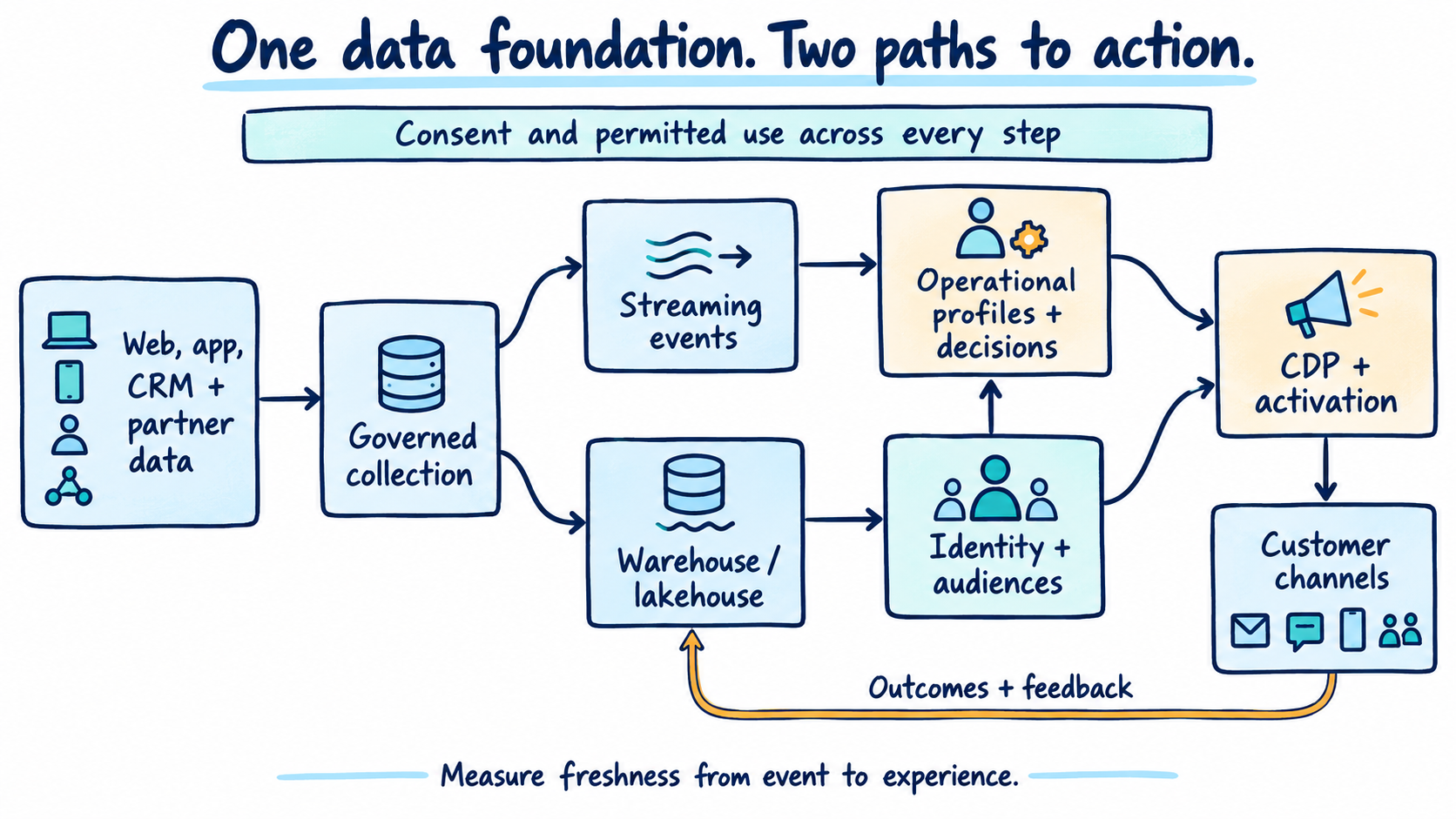
The warehouse supports durable history, analysis, reconciliation, and reusable models. The operational path supports experiences that cannot wait for a full warehouse processing cycle. Depending on the implementation, a packaged CDP may provide several of these capabilities, or composable services may supply them separately.
Both paths need consistent identity and policy rules. Otherwise, a fast system can confidently deliver the wrong experience.
Plug-and-play requires an exit design
I would avoid placing every critical definition inside a single vendor’s interface. But distributing capabilities across vendors also creates dependencies, operational overhead, and failure points. More vendors do not automatically mean more resilience.
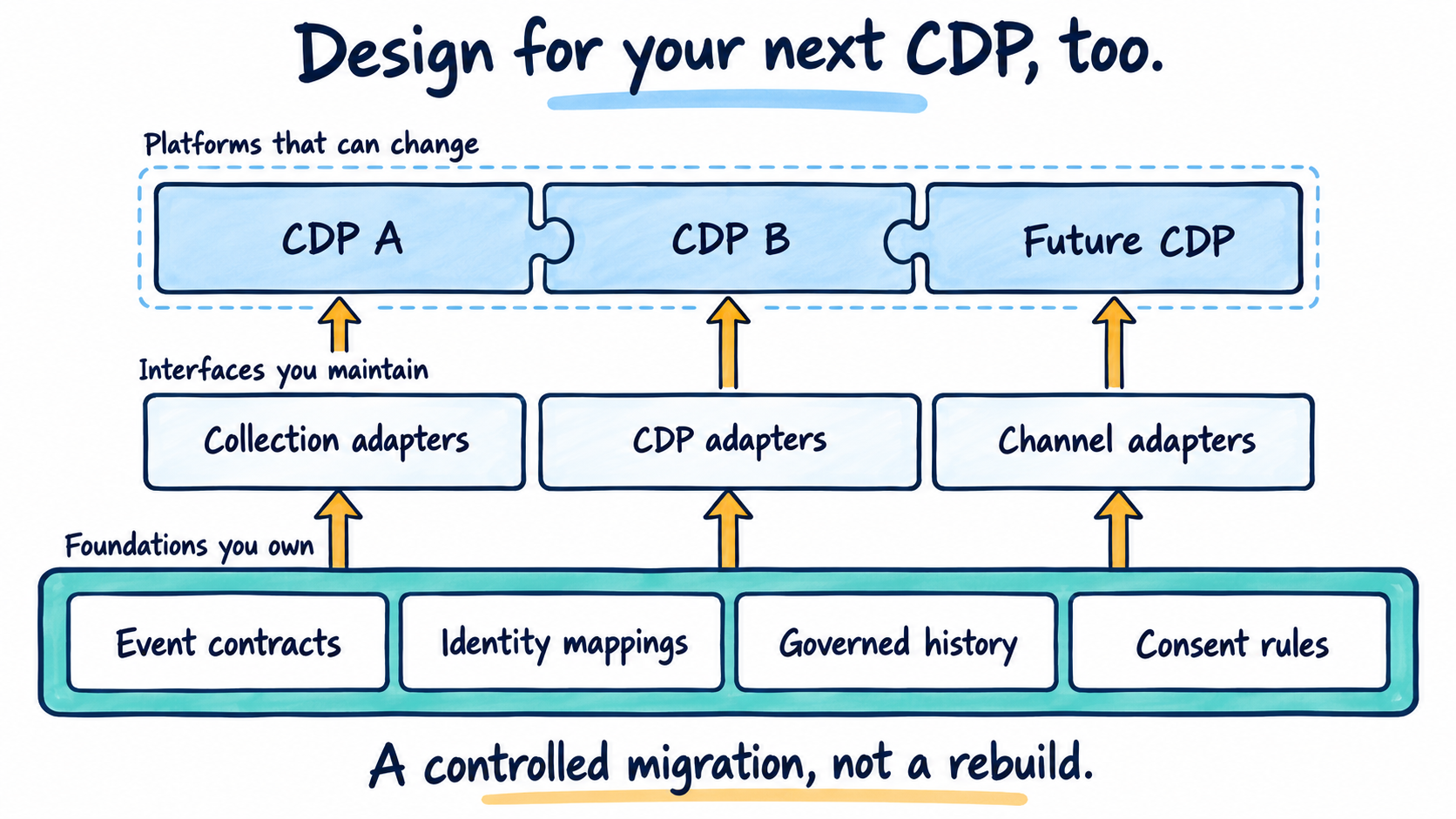
The goal is controlled replaceability:
- Own the event vocabulary and maintain versioned collection contracts.
- Preserve permitted data history and usable identity mappings outside a single activation interface.
- Document audience logic, exclusions, consent rules, and business definitions in portable terms.
- Use adapters to translate shared definitions into each platform’s requirements.
- Capture delivery results and business outcomes in an independent measurement layer.
- Plan exports, retention, deletion propagation, rollback, and transition costs before migration becomes urgent.
A future CDP swap will still require rebuilding some rules, validating identity behavior, reconnecting destinations, and retraining users. “Plug-and-play” should mean a smaller, controlled migration—not an assumption that switching platforms is effortless.
Prove portability by recreating one representative audience in a second environment. Compare membership, exclusions, identity coverage, and destination results. A successful export of a table is only the beginning.
Choose with a customer journey, then test the architecture
I would use three demonstrations: an anonymous visitor becoming a registered user; a permitted partner prospect becoming a known customer; and an existing customer receiving a timely service or onboarding experience.
Ask each vendor to run those scenarios using representative data and the intended destinations. Measure identity errors, usable audience reach, end-to-end latency, suppression behavior, recovery after failure, and total operating cost. Include warehouse compute, data movement, identity services, engineering, monitoring, and experience-delivery tools—not just the CDP subscription.
The conclusion
Protect the foundations.
My preference is to choose a CDP after understanding the data and the experience we want to deliver. A composable approach may fit a team with a mature warehouse and the capacity to operate the pieces. A packaged platform may make more sense when its integrated capabilities help the team deliver. A hybrid design may be the right balance.
Whichever direction we take, I would protect the investment in tagging and data collection. We need to know what an event means, whether it was captured correctly, how it connects to a customer or prospect, and whether we are allowed to use it for the intended purpose.
I want an architecture that works well today and gives us room to change our minds later. That means owning the important definitions, maintaining clear interfaces, and understanding what a migration would involve.
The CDP we choose may change. The care we put into collecting and organizing our data will keep paying off.